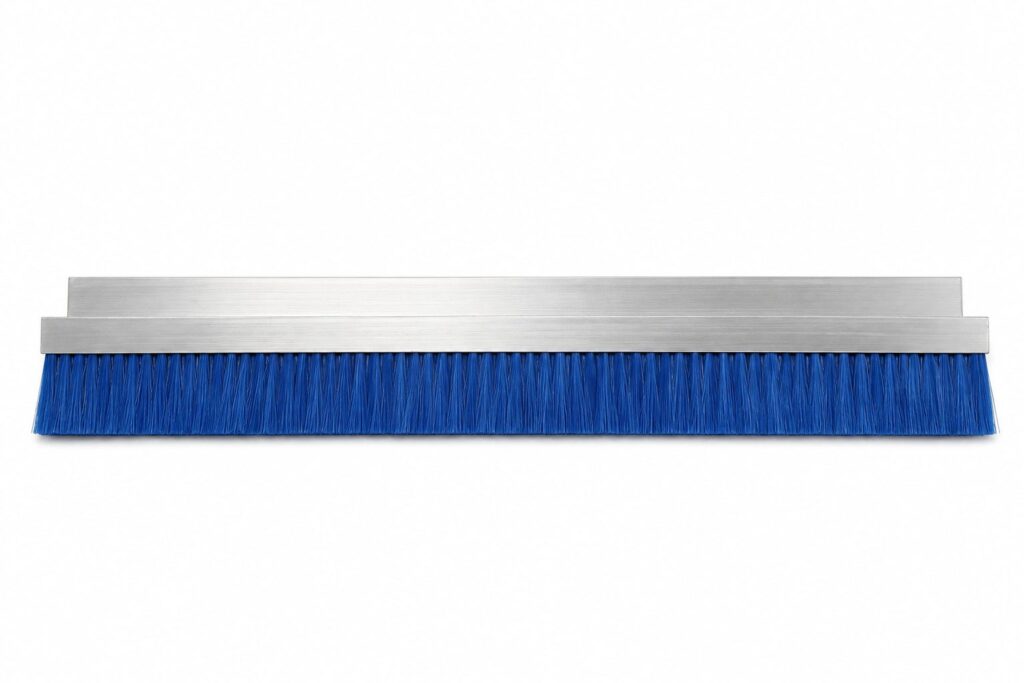
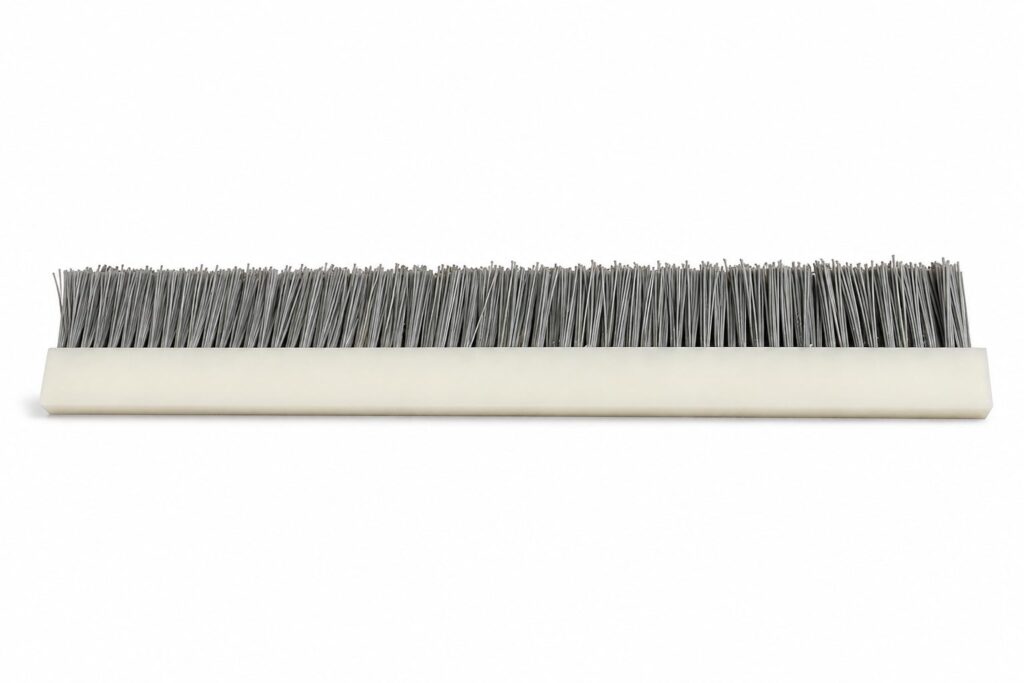
Strip brushes are perfect for sealing spaces and equipment from dust, dirt, noise, smoke and rodents.
They can also be used in production to clean, wash and finish a range of materials from glass to conveyor belts.
These products are commonly used on conveying systems in warehouses, package handling areas, manufacturing facilities, and distribution centres.
The brushes can be slid into an extruded holder, which is called a channel. This allows the brushes to be easily mounted to a surface. There are two sizes of channels that we offer: 4×4 and 9×9 – this refers to the size of the brush that is placed into the channel or holder.
We offer 2 types of strip brushes:
Domestic Strip Brushes:
Specifications: We offer “off-the-shelf ” 4×4 strip brushes and channels. 4×4 refers to the size of the metal base. We supply these in 0.2 polypropylene, and our maximum trim is 40mm (trim refers to the length of the bristle). We can supply with the channel.
Uses: domestic use or for a smaller-sized brush
Industrial Strip Brushes:
Specifications: We offer a more robust brush for industrial applications. These are supplied with the channel, and we can use some different types of bristles
Uses: factories, airport hangars, conveyor belting systems
How They Are Made:
Strip brushes are made by crimping bristle in a metal holder or punching bristle in to a base. Brushes are then trimmed to size.
How They Are Made:
Strip brushes are perfect for sealing spaces and equipment from dust, dirt, noise, smoke and rodents.
They can also be used in production to clean, wash and finish a range of materials from glass to conveyor belts.
These products are commonly used on conveying systems in warehouses, package handling areas, manufacturing facilities, and distribution centres.
Applications:
Strip brushes are perfect for sealing spaces and equipment from dust, dirt, noise, smoke and rodents.
They can also be used in production to clean, wash and finish a range of materials from glass to conveyor belts.
These products are commonly used on conveying systems in warehouses, package handling areas, manufacturing facilities, and distribution centres.
How to Use:
Brushes or channels can be mounted to a machine/door/gate or conveyor belt.
Extras:
The brushes can be slid into an extruded holder, which is called a channel. This allows the brushes to be easily mounted to a surface. We offer 4×4 and 9×9 channels.
There are two sizes of channels that we offer: 4×4 and 9×9 – this refers to the size of the brush that is placed into the channel or holder.
Specifications: Base: HDPE, Nylon or Wood Bristle – Nylon, Polypropylene (PP), Carbide, Tynex, or Brass
What we need to specify it
Send the working width, outer diameter, bore or mounting detail, trim length, fill material, operating speed and a short description of the surface being brushed.
Made around the application
Standard dimensions are useful, but performance depends on contact pressure, fill density and how the brush moves through the job.
Typical specification points
Dimensions
Outer diameter, core diameter, bore, face width and trim length.
Fill material
Polypropylene, nylon, PET, abrasive nylon, stainless steel or brass.
Pattern and density
Straight, staggered or spiral fill selected around coverage and contact.
Strip and Sealing Brushes questions
Can you make a brush from a worn sample?
Yes. Send the old brush, a clear photograph or a drawing. We can work back to the core, bore, fill pattern and bristle specification.
What bristle materials do you work with?
Typical materials include polypropylene, nylon, polyethylene, PET, abrasive nylon, stainless steel and brass. The right choice depends on contact surface, temperature, chemicals and the required action.
How do I choose the fill pattern?
Straight, staggered and spiral patterns meet the work surface differently. We choose the pattern around coverage, contact pressure and how the brush rotates or travels.
How does trim length affect performance?
A shorter trim is stiffer and more aggressive. A longer trim flexes more and gives a sweeping action.